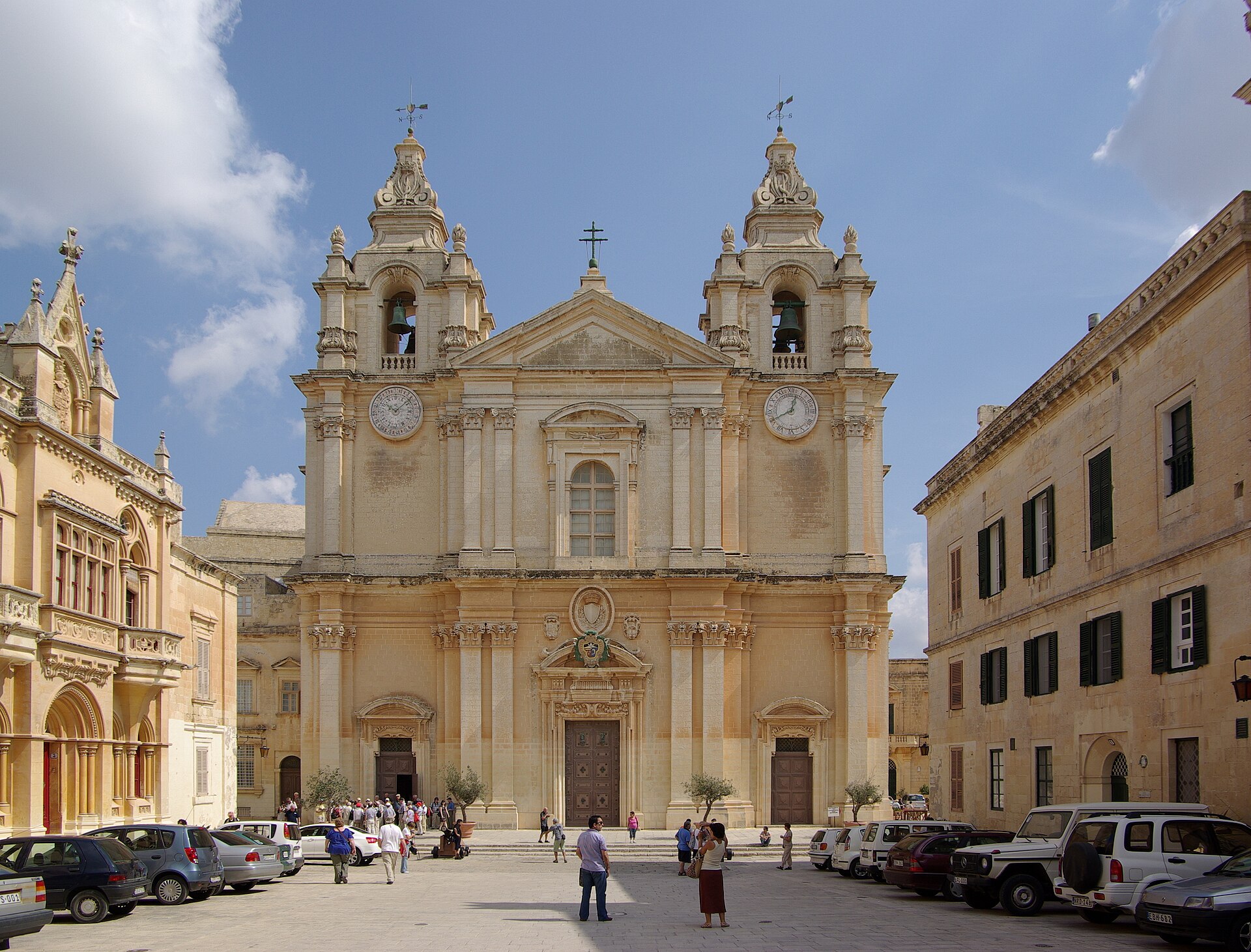
Mdina has been continuously inhabited for around three thousand years, was Malta’s capital for most of that time, and today has a population of roughly three hundred. Cars are largely banned. After the day-trip coaches leave, the streets empty into something close to silence, which is where the nickname comes from. It is one of the most complete small walled cities in Europe, and its layers are unusually legible if you know what to look for.
Three Thousand Years in One Hilltop
The site is a defensible plateau in the centre of the island, and everyone who ruled Malta used it.
- Phoenician, from around 700 BC. The first town on the plateau.
- Roman, from 218 BC, when Rome took the islands from Carthage during the Second Punic War. The Roman city, Melite, was substantially larger than the walled town you see today, roughly three times the area, extending well into what is now the suburb of Rabat. This is the single most useful fact for reading the site: modern Mdina is the shrunken core of a much bigger ancient city, and Rabat is literally the rest of it.
- Arab, from 870 AD. The decisive phase for the town’s shape. The Arabs cut the city down to its present footprint, dug the deep ditch that still fronts the walls, and laid out the narrow, deliberately winding streets; good for shade, and awkward for anyone attacking. They also gave it its name: madinah, the city.
- Norman, from 1091, under Count Roger, and thereafter the seat of the Maltese nobility, whose descendants still own palaces inside the walls.
When the Knights arrived in 1530 they preferred the harbour and settled at Birgu, later building Valletta. Mdina lost its status. and, in a sense, was preserved by that neglect. The old nobility stayed; the money and the modernity went to the coast.
The Earthquake That Rebuilt the Skyline
In 1693 the great Sicilian earthquake struck Malta hard. Mdina’s medieval cathedral was wrecked, along with much else. The reconstruction that followed is why a nominally medieval city has such a strong Baroque face:
- St Paul’s Cathedral was rebuilt between 1696 and 1705 to designs by the Maltese architect Lorenzo Gafà — his masterpiece, and a rare example of a complete, coherent Baroque cathedral built in under a decade.
- The Main Gate, the grand baroque entrance most visitors photograph, dates from 1724. It is not medieval, and the older gate is still visible nearby, bricked up.
The result is the mix people find so distinctive: Norman and medieval fabric in the side streets, Baroque set-pieces on the main axis.
The Saint Paul Tradition
Christian tradition holds that the apostle Paul was shipwrecked on Malta around AD 60, the account is in Acts 28, and was received by Publius, the island’s Roman governor, whose residence is traditionally placed on this hilltop. Publius is said to have become the first Bishop of Malta, and the cathedral stands on the supposed site. As history this rests on a scriptural narrative and long tradition rather than archaeology, but it has shaped Maltese identity for two millennia and explains why the cathedral is here rather than anywhere else.
What to See
- St Paul’s Cathedral and its adjacent museum.
- The bastion walls at the northern edge, the view runs across half the island to the sea, and it is where the city justifies its position.
- Palazzo Falson: a 13th-century house museum, and the best interior in the city.
- The Domus Romana, just outside the walls in Rabat, a Roman townhouse with fine mosaics, and the clearest surviving trace of Melite.
- St Paul’s Catacombs in Rabat, extensive early Christian and Jewish rock-cut burial complexes, and underrated.
Screen note: Mdina’s gate and streets stood in for King’s Landing in the first season of Game of Thrones, which is why parts of it may look oddly familiar.
Visiting Well: Go Late
- The city is at its best in the evening. Coach groups dominate the middle of the day; after about five o’clock the lanes empty and the “Silent City” name starts to make sense. Staying overnight, or visiting after dinner, is a completely different experience.
- Entry to Mdina itself is free. It is a living town, not a site. Individual museums charge.
- Vehicle access is heavily restricted to residents; you park outside and walk in through the gate.
- Pair it with Rabat immediately outside, which holds the Domus Romana and the catacombs, and is where the Roman city actually extended.
Mdina & Rabat Guided Tours
Half-day tours from Valletta or Sliema typically combine Mdina’s walls and cathedral with Rabat’s catacombs; useful given how much of the story sits outside the gate.
PastPathways may earn a commission from bookings made through this link, at no extra cost to you.
Where to Stay Near Mdina
There are a handful of small hotels inside the walls: the way to have the city to yourself at night.
Frequently Asked Questions
Why is Mdina called the Silent City?
Cars are largely banned, only a few hundred people live inside the walls, and once the day visitors leave in the late afternoon the streets become quiet. Visiting in the evening is a different experience entirely.
Is Mdina free to enter?
Yes – it is an inhabited town, not a ticketed site, and walking the streets and walls costs nothing. Individual attractions such as St Paul’s Cathedral, Palazzo Falson and the Domus Romana charge separately.
How old is Mdina?
The plateau has been settled since roughly 700 BC under the Phoenicians. It became the Roman city of Melite from 218 BC, was reduced to its present size and given its name and street plan by the Arabs after 870 AD, and served as Malta’s capital until the Knights moved to the harbour in 1530.
Was Mdina used in Game of Thrones?
Yes – its gate and streets appeared as King’s Landing in the first season.
More on Malta & Gozo
Sources & Further Reading
- Britannica, Mdina
- Heritage Malta, Domus Romana and St Paul’s Catacombs
