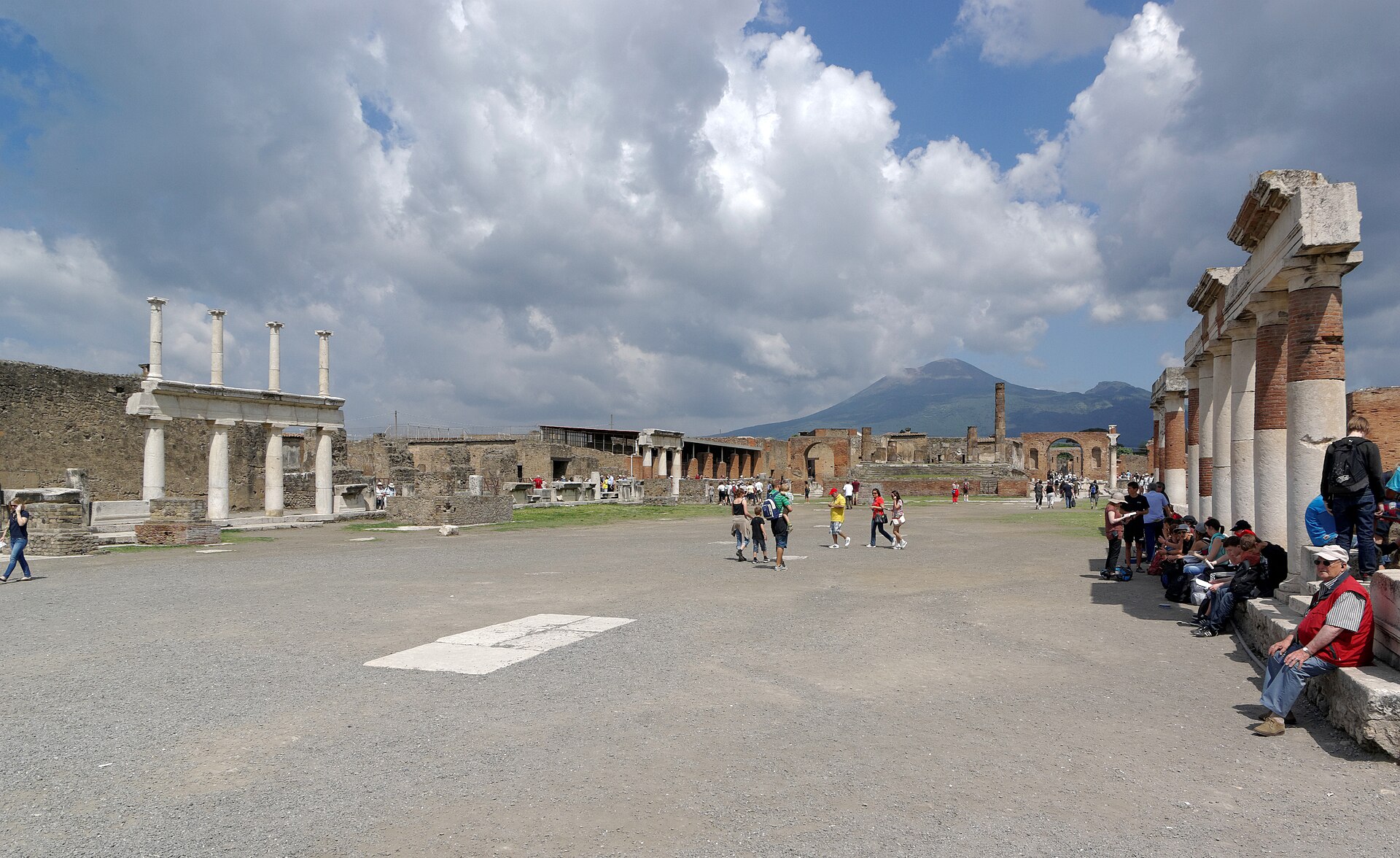
Pompeii is the largest excavated ancient city in the world, and the single most misunderstood day trip in Italy. Most visitors arrive without a plan, walk a fraction of a 66-hectare site in punishing heat, see almost none of what makes it extraordinary, and leave thinking it was overrated. The problem is scale and administration: it is enormous, thinly signposted, and now governed by a booking system that will turn you away at the gate if you get it wrong.
This guide covers the 2026 rules, what actually happened in AD 79, and, most usefully, which houses to prioritise when you cannot see everything.
The 2026 Ticketing Rules (Read This First)
Pompeii changed how entry works, and the changes catch people out daily.
- There is a daily cap of 20,000 visitors. When it is reached. That is it.
- Tickets are named. Your ticket carries your name, and you must bring photo ID that matches it. This is the single most common reason people are refused entry.
- Timed slots apply in peak season (roughly 16 March to 14 October): a morning slot from 9am with the larger share of admissions, and a smaller afternoon allocation from 1pm. Choose morning if you can, the afternoon cap is far tighter and the heat is worse.
- Prices start around €18 for the basic “Pompeii Express” entry, with a fuller €25 ticket that includes the suburban villas.
- Hours: roughly 9am–7pm April to October, 9am–5pm November to March, with last admission well before closing.
- Book in advance. Not optional in high season.
What Actually Happened in AD 79
The eruption killed Pompeii and Herculaneum in two quite different ways, and the difference explains everything you see at each site.
Pompeii, downwind, was first buried under hours of falling pumice. It accumulated metres deep on rooftops until roofs and upper floors collapsed under the weight. Many residents had time to flee, and many did. Only later did pyroclastic surges arrive and kill those who had stayed.
That sequence is why Pompeii is a city of ground floors and open roofs: the upper storeys came down. It is also why the famous plaster casts exist. Bodies decayed inside the hardened ash, leaving voids; from the 1860s, the archaeologist Giuseppe Fiorelli pioneered pouring plaster into those cavities to recover the shape of the dying: a technique that gave us the most affecting objects in archaeology.
What to Prioritise: The Honest Shortlist
You will not see it all. Roughly two-thirds of the city is excavated, and even that is more than a day. If you have three or four hours, go for these:
- The Forum, the civic heart, with Vesuvius framed behind it. Start here for orientation.
- The House of the Faun: the grandest private house in the city, where the Alexander Mosaic was found. What you see in place is a copy; the original is in Naples.
- The Villa of the Mysteries, on the city’s edge, and worth the walk. Its megalographic fresco cycle, showing what appears to be a Dionysiac initiation, is the finest surviving Roman painting anywhere.
- The Stabian Baths, the best-preserved bath complex, with intact stucco and the heating system legible.
- The Lupanar: the brothel, small and always crowded, notable for its frescoes and graffiti.
- The Amphitheatre, the oldest surviving stone amphitheatre in the Roman world (c. 70 BC), predating the Colosseum by well over a century.
- The Garden of the Fugitives; where a group of casts lie where the victims fell.
Excavation continues. The Regio V works of recent years have produced new discoveries. frescoes, a thermopolium (fast-food counter) with painted decoration, inscriptions that have adjusted the eruption’s likely date from August to autumn. This is an active archaeological site, not a finished museum.
The Thing Most Visitors Get Wrong
Here is the honest structural point about visiting Pompeii: most of the treasure is not there. The mosaics, the frescoes, the bronzes, the silver, the erotic art: the great majority was lifted and taken to the National Archaeological Museum in Naples. Visiting Pompeii without the museum is like walking an empty house after the auction. Do both, and the city reassembles itself in your head.
Practical Survival
- Enter at Porta Marina for the classic approach past the Forum, or Piazza Anfiteatro to start at the quieter end and work back.
- There is almost no shade and the streets are original Roman paving — uneven, cambered, and hard on ankles. Proper shoes, hat, and far more water than you think.
- Getting there: the Circumvesuviana train from Naples or Sorrento stops at Pompei Scavi – Villa dei Misteri, right at the gate. It is cheap, frequent and unglamorous.
- A guide helps here more than at most sites, because the signage is thin and the plan is bewildering.
Pompeii Guided Tours & Skip-the-Line Entry
Given the named-ticket system and the scale of the site, a guided entry solves two problems at once. Tours run from Naples, Sorrento and Rome.
PastPathways may earn a commission from bookings made through this link, at no extra cost to you.
Where to Stay
Sorrento and Naples are the usual bases; staying in Pompei town itself gets you to the gate first thing.
The Casts: What DNA Revealed in 2024
The plaster casts are Pompeii’s most famous images, and in 2024 genetics quietly demolished the stories attached to several of them.
First, the method. Bodies buried in ash decayed, leaving voids with the skeleton inside. From 1863, Giuseppe Fiorelli realised those cavities could be filled with liquid plaster and excavated as sculptures. Around 104 casts have been produced this way, from more than a thousand victims recovered across the site.
Because the casts freeze people in poses (huddled, embracing, shielding a child), generations of visitors and guidebooks assigned them family roles. A study published in Current Biology in November 2024, using genome-wide ancient DNA and strontium isotope analysis of skeletal material inside the casts, tested those assumptions against evidence for the first time.
- An individual long presented as a mother cradling a child, complete with a gold bracelet, was genetically male, and not related to the child at all.
- A pair displayed for decades as two sisters, or a mother and daughter, embracing included at least one male, again with no familial relationship.
- The genetic ancestry of those tested points to a cosmopolitan population with substantial eastern Mediterranean heritage, consistent with a port city in a mobile empire rather than a homogenous local one.
The authors’ wider point is methodological and worth carrying around any archaeological site: the poses invited a narrative, the narrative hardened into fact, and the assumptions embedded in it, about gender, about who comforts whom, turned out to be ours rather than theirs. Casts on display are also, in places, partly reconstructed and restored, which complicates reading them as direct photographs of the dying.
Two Buildings Worth Going Out of Your Way For
The House of the Vettii
Reopened in January 2023 after roughly two decades of restoration. This is the best-restored elite house in the city and the most socially interesting. It belonged to Aulus Vettius Conviva and Aulus Vettius Restitutus, by the evidence of their names, freedmen, former slaves who had become wealthy enough to own one of Pompeii’s showpiece houses. Its decoration is famously exuberant, including the Priapus fresco at the entrance that appears in every book about Roman attitudes to fertility and the evil eye. As a document of social mobility in a Roman town it is unmatched.
The Thermopolium of the Rooster (Regio V)
Excavated from 2019 and opened to visitors in August 2021, this is a Roman fast-food counter with its painted decoration intact, including a depiction of the rooster that gives it its name, and food residues still in the embedded dolia jars. Work continuing through 2023 and 2024 uncovered the service rooms behind it and a small upper-floor apartment, almost certainly where the shopkeepers lived above the shop.
One find from that work is a small masterpiece of ordinary life: a refined glass-paste situla made in Alexandria, decorated with Nilotic hunting scenes, an expensive imported ornament that had ended up in the back kitchen being used as a everyday container. Pompeii is full of that kind of detail if you know to look for it.
Reading the City: A Few Things to Notice
- The stepping stones across the streets sit at cart-wheel spacing; streets doubled as drainage and were routinely awash.
- The raised pavements and kerbs are unusually high for the same reason.
- Graffiti is everywhere and much of it is published: election notices, insults, prices, declarations of love. Pompeii is the best surviving record of Roman writing by non-elite people.
- Lead water pipes and public fountains survive at junctions; the city had pressurised water from an aqueduct, distributed via a water tower.
- Look for the phalluses carved into paving and walls. They are apotropaic, luck and protection against the evil eye, not, as tour guides sometimes claim, directions to the brothel.
Frequently Asked Questions
Do you need to book Pompeii tickets in advance?
In peak season, effectively yes. Pompeii caps entry at 20,000 visitors a day and uses timed slots from mid-March to mid-October. Tickets are also named, and you must bring photo ID matching the ticket – the most common reason visitors are refused at the gate.
How long do you need at Pompeii?
Three to four hours covers a focused route through the Forum, House of the Faun, Stabian Baths, Lupanar and Amphitheatre. A full day lets you add the Villa of the Mysteries and the quieter outer regions.
Why are Pompeii’s best mosaics not at Pompeii?
Most portable finds – the Alexander Mosaic, frescoes, bronzes and the erotic collection – were moved to the National Archaeological Museum in Naples. What you see in place is often a replica, so pairing the site with the museum matters.
Pompeii or Herculaneum – which is better?
Pompeii is far larger and gives the scale of a Roman city; Herculaneum is much smaller but dramatically better preserved, with wooden doors, furniture and upper floors intact. If you have one day, choose by preference; if you have two, do both.
Sources & Further Reading
- Pilli, Vai et al. (2024), “Ancient DNA challenges prevailing interpretations of the Pompeii plaster casts,” Current Biology
- Parco Archeologico di Pompei, official timetables and tickets
- UNESCO, Archaeological Areas of Pompeii, Herculaneum and Torre Annunziata
