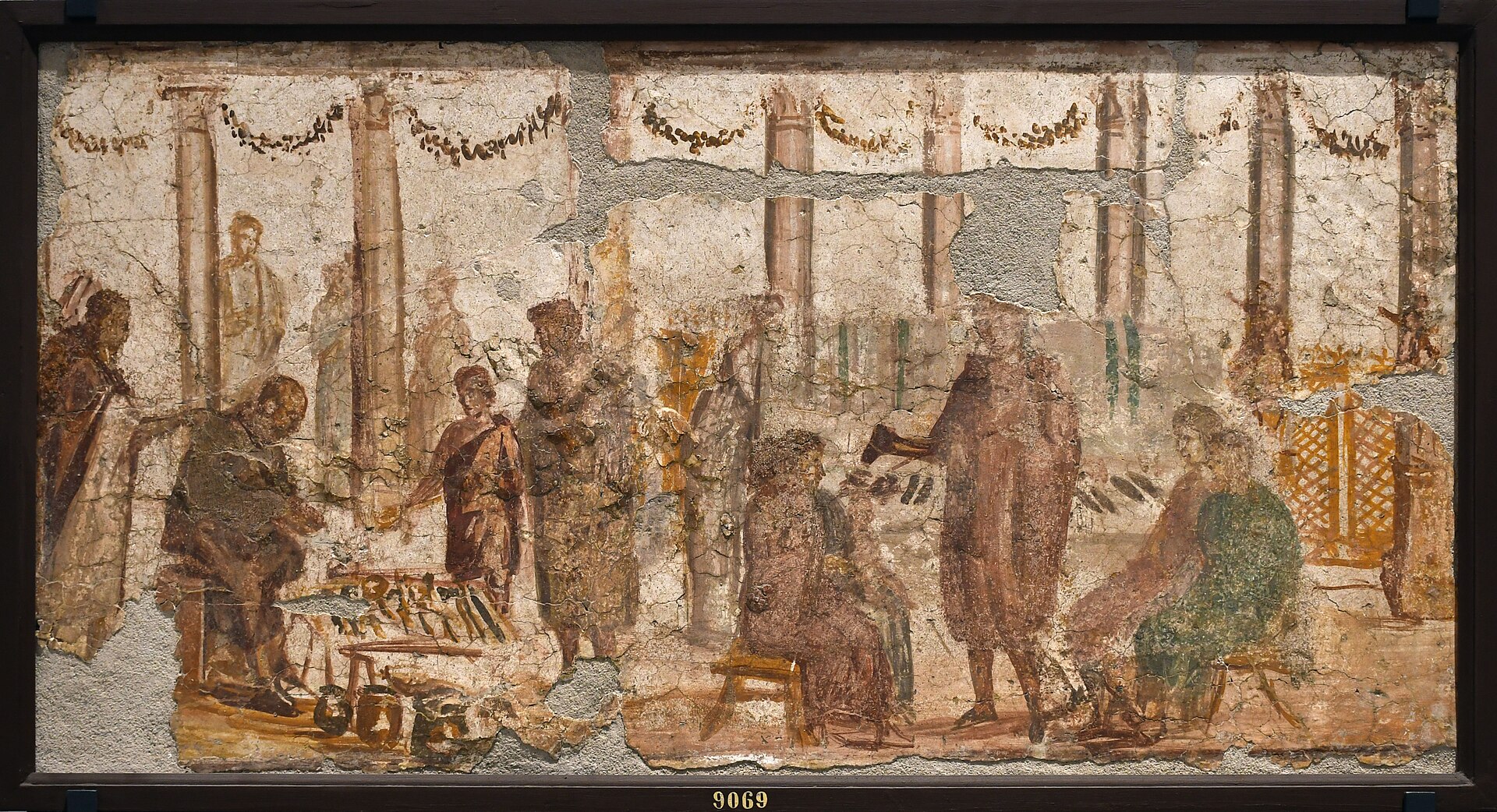
If you visit Pompeii and skip the National Archaeological Museum in Naples, you have seen the building and missed the contents. Nearly everything portable and precious excavated from Pompeii and Herculaneum, the mosaics, the wall paintings, the bronzes, the silver, the lamps, the surgical instruments, the erotica, is here. Much of what you photograph on site is a replica of something in this building.
What Makes MANN Exceptional
The museum sits on two great collections at once.
The Vesuvian material
- The Alexander Mosaic; lifted from the House of the Faun at Pompeii, showing the Battle of Issus between Alexander and Darius III. It is built from over a million tesserae and is the most important surviving Roman mosaic anywhere. Almost certainly a copy of a lost Hellenistic painting, which makes it a window onto Greek art that no longer exists.
- The fresco galleries. entire painted walls removed from Pompeian houses, including the still lifes and mythological panels that define our mental image of Roman domestic art.
- Everyday objects: the part people find unexpectedly moving. Bronze cooking pans, dice, surgical tools, jewellery, a carbonised loaf.
The Farnese Collection
Inherited Renaissance antiquities of the first rank, on the ground floor:
- The Farnese Hercules, the exhausted, over-muscled hero leaning on his club, a signed 3rd-century AD copy of a Greek original, recovered from the Baths of Caracalla in Rome.
- The Farnese Bull: the largest surviving sculptural group from antiquity, carved from a single colossal block, also from the Baths of Caracalla.
The Secret Cabinet
The Gabinetto Segreto holds the erotic material from Pompeii and Herculaneum, frescoes, objects, phallic charms, which was considered so indecent that for long stretches of its history it was locked away, accessible only to scholars of “mature age and respected morals,” and at points bricked shut entirely. It is now a normal part of the visit, and it is informative about how differently Romans handled sexuality and apotropaic magic. (Parental discretion applies.)
Practical
- Open Tuesday to Sunday, roughly 9am–7:30pm. Closed Mondays, which catches out a lot of people who planned Pompeii and the museum on consecutive days.
- Admission around €15.
- Allow three to four hours minimum. It is a big, old-fashioned museum and rewards slowing down.
- Order matters. Ideally do the museum after Pompeii, when you can place each object in a room you have walked through. If that is not possible, doing it first still beats not doing it.
- It sits in central Naples, on the metro (Museo/Cavour).
Guided Visits to MANN
A guide is useful here, the labelling is sparse by modern standards and the collection is vast.
PastPathways may earn a commission from bookings made through this link, at no extra cost to you.
The Alexander Mosaic in Detail
It is worth knowing what you are looking at, because on a busy day people walk past it in ninety seconds.
- Scale and construction: roughly 5.8 by 3.1 metres, assembled from somewhere between one and a half and two million tesserae — tiny stone cubes, in places only a couple of millimetres across, laid in curving rows to model muscle and shadow.
- Subject: almost certainly the Battle of Issus (333 BC), with Alexander at left driving into the Persian line and Darius III at centre-right, face contorted, wheeling his chariot to flee. The emotional centre is not Alexander but Darius, and a dying Persian reflected in a polished shield.
- What it copies: it is generally held to reproduce a lost Hellenistic painting, sometimes attributed to Philoxenos of Eretria. That makes this floor in a Pompeian house our clearest surviving window onto Greek monumental painting, an art form otherwise almost entirely lost.
- Where it came from: the exedra floor of the House of the Faun at Pompeii, itself an enormous residence, larger than many royal palaces of the period.
- Condition: it underwent a major multi-year conservation and structural project completed recently, having spent decades mounted vertically on a wall, which placed stresses on it that it was never built to take.
The Farnese Marbles
The ground floor holds sculpture of an entirely different provenance: the Farnese collection, inherited by the Bourbon kings of Naples, much of it excavated from the Baths of Caracalla in Rome in the 16th century.
- The Farnese Hercules; over three metres tall, a signed copy by Glykon of Athens after a lost original attributed to Lysippos. The hero is shown exhausted after the labours, leaning on his club, holding the apples of the Hesperides behind his back. Its rediscovery had an enormous influence on Renaissance and Baroque art.
- The Farnese Bull, the largest surviving sculptural group from antiquity, carved from a single colossal block of marble and standing around four metres. It shows the punishment of Dirce, tied to a bull by the sons of Antiope. Michelangelo was among those involved in its restoration after discovery.
How to Actually Use the Museum
MANN is large, old-fashioned and lightly labelled, and most visitors drift. A workable route:
- Ground floor first for the Farnese marbles while you are fresh. They are physically overwhelming and reward standing still.
- Mezzanine for the mosaics, ending at the Alexander Mosaic. Give it ten minutes, not one.
- The Secret Cabinet is on the mezzanine level too. small, and best understood after the mosaics have shown you how ordinary decorative art was in these houses.
- First floor for the frescoes and the everyday objects: the Villa of the Papyri bronzes, the glassware, the surgical instruments, the carbonised bread.
If you are visiting Pompeii on the same trip, note that many of the finest floors and walls you will see in situ are replicas; the originals are here. Doing the site first and the museum second lets you put each object back in the room it came from.
Frequently Asked Questions
Is the Naples Archaeological Museum worth visiting?
If you are visiting Pompeii or Herculaneum, it is close to essential. Most portable finds – the Alexander Mosaic, the frescoes, the bronzes and the erotic collection – were moved here, and what remains on site is often a replica.
What is the Secret Cabinet?
The Gabinetto Segreto holds erotic art and objects from Pompeii and Herculaneum. It was locked away for much of its history, at points bricked up, and open only to approved scholars. It is now part of the normal visit.
When is the museum closed?
It closes on Mondays, opening Tuesday to Sunday roughly 9am to 7:30pm. Plan around this if you are combining it with Pompeii.
How long do you need at MANN?
Three to four hours minimum for the Farnese sculptures, the Alexander Mosaic, the fresco galleries and the Secret Cabinet.
Sources & Further Reading
- MANN, collection highlights
- Museo Archeologico Nazionale di Napoli, official site
- Britannica, the Alexander Mosaic
