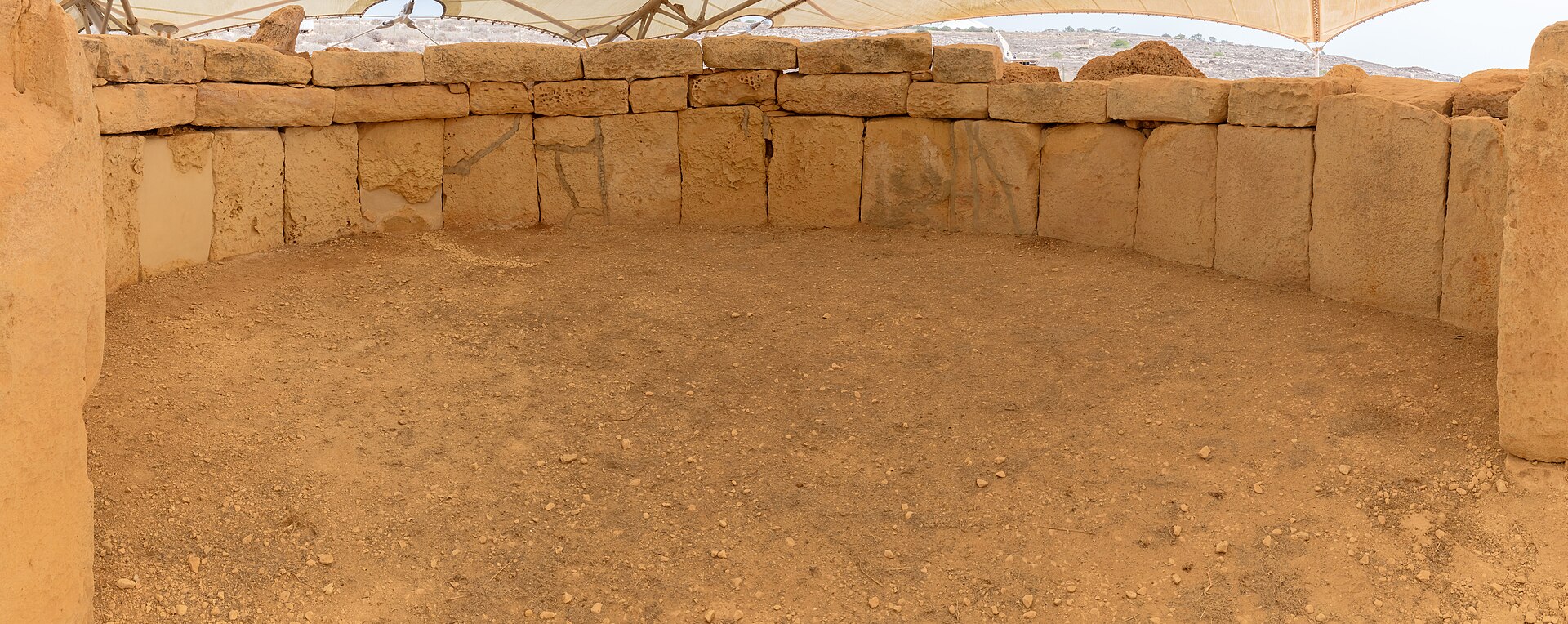
On a bare, wind-scoured slope above Malta’s southern cliffs stand two temple complexes older than Stonehenge, older than the pyramids of Giza, and older than any other free-standing stone architecture known on earth. Ħaġar Qim and Mnajdra sit roughly 500 metres apart, built by the same culture across several centuries, and one of them functions, with genuine precision, as a solar calendar.
This is a guide for people who want to understand what they are looking at: the construction, the astronomy, the debate about the shelters covering them, and how to time a visit for the equinox or solstice.
Two Temples, Two Different Stones
The distinction between these sites begins with geology, and it explains almost everything about their condition today.
- Ħaġar Qim (c. 3600–3200 BC) was built almost entirely from globigerina limestone, a soft, golden, easily worked stone quarried locally. It carves beautifully. It also weathers badly. One of its megaliths is among the largest used anywhere in the Maltese islands, standing over five metres and weighing on the order of twenty tonnes.
- Mnajdra, downslope, used harder coralline limestone for its outer walls, with globigerina reserved for interior work. It has consequently survived in better structural condition.
Mnajdra is not one temple but three, built at different times: the East (or Upper) temple around 3500 BC, with the South and Central temples following around 3000 BC. The South temple is the one that matters astronomically.
The Solar Calendar at Mnajdra South
This is the most remarkable thing on Malta, and it happens on a schedule.
- At the equinoxes (around 20 March and 22 September), the rising sun shines directly through the main doorway and straight down the central corridor, illuminating the axis into the innermost apse.
- At the solstices, the effect shifts to the edges. At the summer solstice sunrise, a blade of light strikes the edge of a megalith on one side of the first apse; at the winter solstice, it falls on the corresponding stone on the opposite side.
Taken together, the three events mark the extremes and midpoint of the solar year against fixed stones: a working calendar built into architecture around five thousand years ago.
A scholarly caveat worth stating. Archaeoastronomy is a field where wishful pattern-matching is a genuine hazard, and papers debating the intentionality of the Mnajdra alignments continue to appear. The alignments themselves are observable and repeatable. You can go and watch them. Whether every claimed secondary alignment was designed, or is a by-product of a doorway facing broadly east, remains argued. The equinox and solstice effects at Mnajdra South are the well-supported core; treat longer lists of alignments with more caution.
The Shelters: Malta’s Most Divisive Conservation Decision
Since 2009 both temples have stood beneath large fabric canopies on steel frames, and visitors are frequently surprised, and sometimes disappointed, by them. The reasoning is straightforward: globigerina limestone at Ħaġar Qim was actively dissolving under rain, salt spray and thermal cycling, and measurable deterioration was ongoing. The shelters stopped it.
They also, unavoidably, alter the experience and the photographs, and they have been criticised on exactly those grounds. It is a real trade-off between preservation and presentation, and worth knowing about before you arrive rather than after.
One further note: in April 2001 Mnajdra was seriously vandalised when intruders toppled and damaged megaliths overnight. Site security was overhauled afterwards. It is a reminder of how fragile these places are.
What Was Found Here
Ħaġar Qim produced some of the most significant portable art of the Maltese temple period, including several of the corpulent seated and standing figures conventionally, and probably misleadingly, called “fat ladies,” along with the small figure known as the Venus of Malta. The originals are in the National Museum of Archaeology in Valletta; what stands on site are replicas. Notably, no burials were found in the temples themselves, the dead went underground, at places like the Ħal Saflieni Hypogeum. That separation of the living cult and the dead is one of the defining features of this culture.
Visiting: Timing, Access and the Solstice Events
- The two temples share a single ticket and visitor centre, which includes a short introductory film and an exhibition. Allow two hours for both sites properly; the walk between them is downhill on the way out and uphill coming back, on an exposed path.
- There is almost no shade. In summer, go early or late; midday here is punishing.
- Solstice and equinox viewings are ticketed separately and in advance through Heritage Malta, with limited places, early-morning access before normal opening. If you want to see the alignment, plan the trip around it. These fill up.
- The site sits near the Blue Grotto and Dingli Cliffs, and combines naturally with both.
- Both temples form part of the UNESCO-listed Megalithic Temples of Malta.
For the wider picture across the islands, Tarxien, Skorba, Ta’ Ħaġrat and Ġgantija on Gozo, see our guide to Malta’s megalithic temples.
Frequently Asked Questions
When does the sun align at Mnajdra?
At the spring and autumn equinoxes (around 20 March and 22 September) the sunrise shines straight down the central corridor of Mnajdra South. At the summer and winter solstices, a blade of light strikes the edges of megaliths on opposite sides of the first apse. Heritage Malta sells limited advance tickets for these early-morning viewings.
Why are Hagar Qim and Mnajdra covered by tents?
The shelters were installed in 2009 to halt active erosion of the soft globigerina limestone by rain, salt and temperature cycling. They work, but they change the look of the site and remain a debated conservation trade-off.
How old are Hagar Qim and Mnajdra?
Hagar Qim dates to roughly 3600-3200 BC. Mnajdra’s East temple is around 3500 BC, with its South and Central temples around 3000 BC – older than Stonehenge and the Egyptian pyramids.
Can you visit both on one ticket?
Yes. The two temples share a visitor centre and a single ticket, and are about 500 metres apart on foot. Allow around two hours in total.
More on Malta & Gozo
Sources & Further Reading
- UNESCO World Heritage Centre, Megalithic Temples of Malta
- Heritage Malta, Ħaġar Qim and the official solstice & equinox leaflet (PDF)
- Academic discussion of alignment intentionality at Mnajdra, paper
