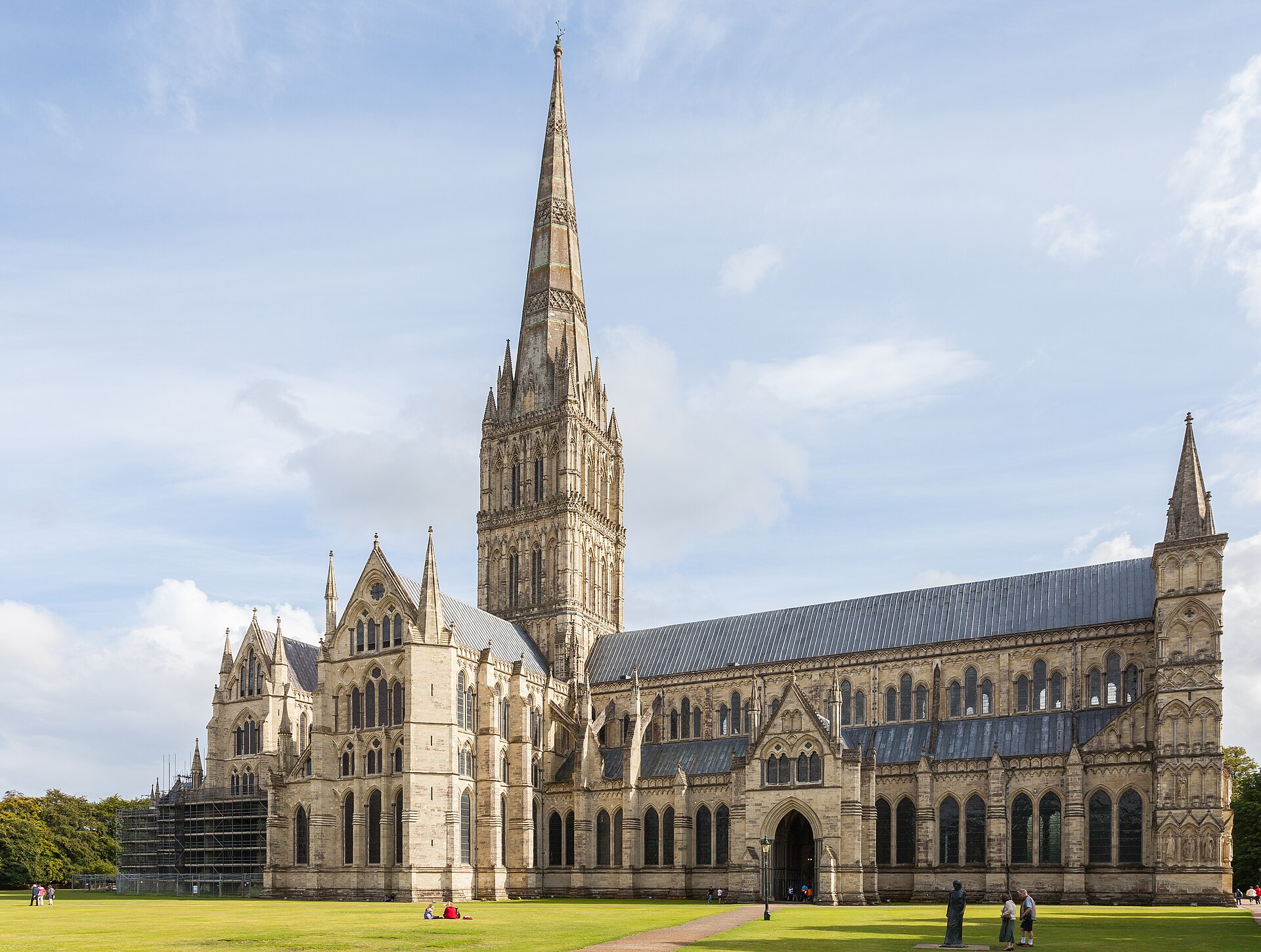
You can stand a few feet from a sheet of parchment that a medieval king was forced to seal in 1215, the document that first put in writing the idea that even the king answers to the law. Salisbury’s copy of Magna Carta is the best-preserved of the four that survive, and it sits inside one of the purest Gothic cathedrals in Europe, under the tallest spire in Britain. For a place this important, it’s refreshingly easy to visit, and it pairs perfectly with Stonehenge nine miles up the road. Here’s how.
What Makes Salisbury Special
Salisbury Cathedral is the rare medieval cathedral built fast and to one plan. Per Salisbury Cathedral, the main body went up between 1220 and 1258, which is why it has such a unified Early English Gothic style, most cathedrals took centuries and show it. The spire came a little later and, at 123 metres (404 feet), is still the tallest in the UK. It also holds what’s generally called the world’s oldest working mechanical clock (around 1386) and the largest cloister and cathedral close in Britain.
But the reason to make the trip is the Magna Carta. In 1215 England’s barons forced the deeply unpopular King John to seal a charter limiting royal power: an idea that echoes through English law, the US Constitution and modern human rights. Only four original 1215 copies survive; Salisbury’s, displayed in the 13th-century Chapter House, is the finest of them (the British Library holds two of the others).
Getting There
Direct trains from London Waterloo reach Salisbury in about 90 minutes, and the cathedral is a short walk from the station. Salisbury is also the obvious gateway to Stonehenge, which is just 9 miles (about 20 minutes) away; see our Stonehenge guide to plan the pairing.
Best Salisbury & Stonehenge Tours
Stonehenge & Salisbury Cathedral (Magna Carta) Day Trip — Best Overall
A private day pairing the prehistoric wonder with the medieval one. Stonehenge, then Salisbury’s cathedral and its original Magna Carta. Nearly 5,000 years of history at a sensible pace.
Private Tour of Stonehenge & Salisbury Cathedral — Best Private Option
A flexible private day trip from London to both, with the driving and logistics handled so you can focus on the history.
PastPathways may earn a commission from bookings made through these links, at no extra cost to you.
Visiting the Cathedral: What to Know
- Entry is now a timed ticket, not a donation (older guides still say otherwise): about £12.50 booked ahead, £14.50 on the day, under-12s free. Your ticket is valid for a full year of return visits, and seeing Magna Carta is included.
- The tower tour is the splurge worth making. A separate timed ticket (about £25 adult), 332 steps to roughly 68 metres at the base of the spire, 90–105 minutes. Minimum age 7, height 1.2 m. It sells out — book ahead.
- Time it for Evensong. The sung service (most days, free to attend) fills the building with choral music the way it was built to be heard, one of the best free things to do in England.
- Find the medieval clock and the modern font. The 1386 clock still ticks near the entrance; the contemporary cruciform font mirrors the vaults in still water and is quietly stunning.
Nearby: Old Sarum
Salisbury is a “new” town, the original cathedral and settlement stood at Old Sarum, the dramatic Iron Age hillfort just north of the city, abandoned in the 13th century when the community moved down to the meadows. Its earthworks and ruins (English Heritage) make an easy add-on.
Where to Stay in Salisbury
Salisbury is an excellent base for Stonehenge, Avebury and the wider Wiltshire landscape. Compare hotels and inns near the cathedral below.
Frequently Asked Questions
Is there an entry fee for Salisbury Cathedral?
Yes: the cathedral now charges timed admission, around £12.50 in advance or £14.50 on the day, under-12s free, valid for a year of return visits. It includes Magna Carta. The tower tour is a separate ticket (about £25).
Which Magna Carta is at Salisbury?
One of only four surviving original 1215 copies, and widely considered the best preserved of the four. It’s displayed in the cathedral’s 13th-century Chapter House.
How far is Salisbury from Stonehenge?
About 9 miles, or a 20-minute drive, which is why the two are so often combined into one day trip.
Why the Spire Should Not Still Be Standing
- The spire was an afterthought, and it nearly broke the building. Added around 1310–1330, a generation after the cathedral was finished, the tower and spire dumped roughly 6,500 tonnes onto a church never designed to carry them.
- It stands on foundations barely 4 feet deep. The water table on the meadow site allowed nothing deeper. For the tallest spire in Britain. That is remarkable.
- The four crossing piers are visibly bent. You can see them bowing inward under the load.
- Christopher Wren measured the lean in 1668 and found the spire about 75 cm out of true. He added iron tie-rods to hold it. A brass plate in the crossing floor lets surveyors re-check the deflection, and it hasn’t moved significantly since.
- The medieval scaffolding is still inside the spire. The wooden framework used to build it around 1330 was never removed. You see it on the tower tour, roughly 700 years on.
- The clock has no face. Made of hand-wrought iron in or before 1386, it only ever struck the hours on a bell. It was rediscovered by accident in the tower in 1928. (Its claim to be the world’s oldest working clock is disputed by horologists who favour Wells.)
- The cathedral close is about 80 acres, the largest in Britain, with the largest cloisters too.
- Magna Carta got here in 1215, probably carried by Elias of Dereham, who was present when King John agreed the charter and later oversaw building the new cathedral. Two of the other three originals are at the British Library; the fourth is at Lincoln.
- The font is a mirror. William Pye’s 2008 cruciform font holds water so still it reflects the vaults, overflowing continuously from four corners, the most photographed thing in the building.
- Constable painted it obsessively, most famously Salisbury Cathedral from the Meadows (1831, Tate).
- Old Sarum, the abandoned original site, became Britain’s most notorious “rotten borough”; almost no residents, yet it returned two MPs until the 1832 Reform Act.
Sources & Further Reading
- Salisbury Cathedral, History and Magna Carta
- British Library, Magna Carta
- English Heritage. Old Sarum
