
The Orkney Islands, scattered just beyond Scotland’s northern coast, form one of the most astonishing archaeological landscapes in the world. Long before the rise of the Egyptian pyramids or Stonehenge, Orkney’s early inhabitants were erecting complex structures, ritual sites, and dwellings—many of which still stand today. This guide explores the most significant Neolithic sites across the archipelago, weaving in expert commentary and the latest archaeological discoveries to help readers understand exactly why Orkney is often described as the “Stone Age Capital of Europe.”
Adding to its global significance, Orkney’s most iconic archaeological sites are collectively designated as the Heart of Neolithic Orkney, a UNESCO World Heritage Site since 1999. This includes Skara Brae, Maeshowe, the Standing Stones of Stenness, and the Ring of Brodgar. The designation recognizes not only the age and preservation of these monuments but also their cultural and ceremonial importance, revealing a complex prehistoric society with advanced knowledge of architecture, astronomy, and ritual life.
While the Ness of Brodgar is not one of the four originally inscribed sites, it is widely considered a significant contributing element. Many archaeologists argue it may be the key to understanding how the other monuments were functionally and spiritually linked, making Orkney’s archaeological zone one of the most interconnected and important Neolithic landscapes in the world.
Map of Recommended Orkney Archaeology Sites
🪨 Skara Brae: Europe’s Best-Preserved Stone Age Village
Historical Context
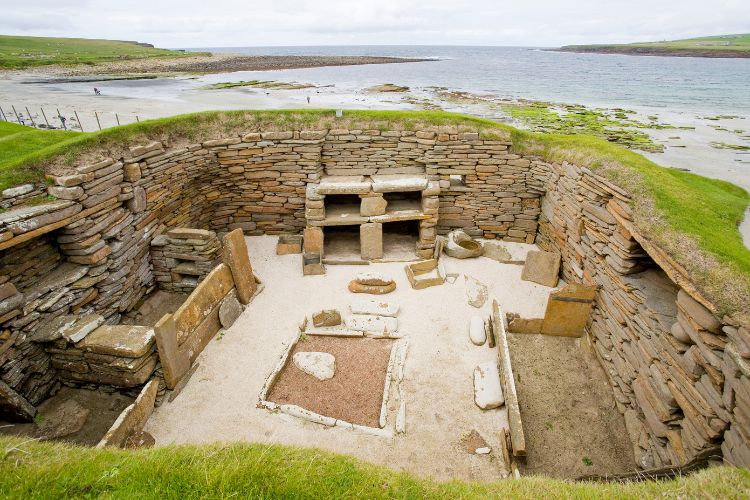
Skara Brae was buried under sand dunes for millennia until a fierce storm in 1850 stripped away the earth and revealed a remarkably intact prehistoric village. Archaeologists have dated the site to approximately 3100 BCE, making it older than both Stonehenge and the Great Pyramids. It consists of ten interlinked stone dwellings complete with stone-built furniture, fire pits, and even primitive drainage systems. The level of preservation is so extraordinary that it’s often dubbed the “Scottish Pompeii.”
What Archaeologists Say
Dr. Caroline Wickham-Jones, a leading archaeologist specializing in Orkney, once told the BBC: “Skara Brae provides us with a window into a time that’s otherwise largely lost. These people weren’t primitive—they were highly organized, sophisticated, and social.” (BBC Scotland)
A recent National Geographic feature highlighted the site’s potential to reframe our understanding of community life in Neolithic Europe. Radiocarbon dating, isotopic analysis, and artifact studies suggest that the residents of Skara Brae engaged in complex trade networks and had a deeply ritualistic culture. (National Geographic, “Europe’s Lost World,” 2022)
What to Expect & How to Visit
Visitors can walk alongside the low walls of the original houses, peering into a world over 5,000 years old. There’s also a modern visitor center with interactive exhibits and a reconstructed house to help bring the site to life.
- Getting There: Located on Mainland Orkney’s west coast, about 30 minutes by car from Kirkwall.
- Access: Open year-round (limited hours in winter). Tickets can be purchased on-site or online via Historic Environment Scotland.
- Tour Options: Skara Brae-focused archaeology day tours often include Skaill House, just next door.
🌞 Maeshowe: A Solar-Aligned Tomb with Viking Graffiti
Historical Context
Maeshowe is one of the most architecturally advanced tombs of Neolithic Britain. Built around 2800 BCE, its entrance passage is precisely aligned with the setting sun during the winter solstice. On that day, sunlight travels through the narrow corridor and illuminates the central chamber—an intentional design likely linked to Neolithic cosmology and ritual practices.
What Archaeologists Say
Maeshowe has fascinated scholars for centuries. Sir Walter Scott visited it in the 19th century, and modern experts like Dr. Antonia Thomas (UHI Archaeology Institute) continue to study the site’s alignment and stonework. In a 2022 lecture, she noted: “Maeshowe is not just a tomb—it’s a clock, a temple, and a cultural archive all in one.” (UHI Orkney Lecture Series)
What makes Maeshowe especially unique is the later Norse graffiti carved into its walls. During the 12th century, Viking crusaders broke into the tomb and left behind runic inscriptions—some spiritual, others comical or raunchy—giving us a rare human connection across eras.
What to Expect & How to Visit
Guided tours offer access to the interior, but spots are limited and should be booked in advance. Inside, you’ll see both the Neolithic craftsmanship and the Viking carvings firsthand.
- Getting There: Located about 20 minutes west of Kirkwall.
- Access: Access is only by guided tour; reserve in advance through Historic Environment Scotland.
- Tour Tip: Combine with nearby Brodgar and Stenness sites on a full-day prehistory tour.
🔘 Ring of Brodgar: Monumental Ceremonial Architecture
Historical Context
With an original diameter of 104 meters and 60 stones (36 remain today), the Ring of Brodgar is one of the largest and most complete stone circles in the British Isles. It is believed to have been constructed between 2500 and 2000 BCE, likely as a ceremonial or astronomical site. Its exact purpose remains mysterious, but its orientation and location suggest alignments with lunar and solar events.
What Archaeologists Say
According to Professor Colin Richards, who has led excavations at Brodgar, “The Ring was not just a religious space—it was political, communal, and performative.” (BBC Radio Orkney interview, 2021) His team discovered evidence of feasting, fires, and mass gatherings in and around the henge, reinforcing the idea of Brodgar as a focal point of Neolithic Orkney society.
A recent episode of Time Team Special Reports described it as “a cathedral of the Neolithic world, central to rituals and community cohesion.” (Time Team YouTube Channel)
What to Expect & How to Visit
Today, visitors can walk freely around the stones (no ticket required). Panels provide context, and guided walks are occasionally hosted by Historic Environment Scotland or local historians.
- Getting There: Easily reached via car or bus from either Kirkwall or Stromness (~15–20 minutes).
- Access: Free and open 24/7. Sunrise and sunset visits are especially atmospheric.
- Tour Options: Often combined with Ness of Brodgar and Standing Stones of Stenness.
🪓 Ness of Brodgar: An Ongoing Archaeological Revelation
Update: the Ness of Brodgar excavation ran its final season in 2024. After twenty-one years the trenches were recorded, covered with protective membrane and backfilled, so there is no open dig to visit. The site is now a grassed mound between the Stones of Stenness and the Ring of Brodgar, with interpretation boards. Finds are displayed at the Orkney Museum in Kirkwall. We cover the full story in our guide to the Ness of Brodgar dig.
Historical Context
Discovered in 2003, the Ness of Brodgar has quickly become one of Europe’s most important ongoing excavations. It sits between the Ring of Brodgar and the Stones of Stenness and appears to have been a major ceremonial complex, with buildings dating from 3300 to 2300 BCE.
What Archaeologists Say
Nick Card, director of the dig, told The Guardian: “What we are seeing at Ness is unparalleled in scale and complexity. It’s changing how we think about Neolithic society—not just in Orkney, but in all of Europe.” (The Guardian, 2016)
Findings include massive stone structures with painted walls, polished stone tools, figurines, and even evidence of early roofing techniques. Researchers believe the site functioned as a sacred gathering space for centuries, possibly serving a pan-Orcadian or even wider cultural purpose.
What to Expect & How to Visit
The dig site is only open to the public during the summer dig season (typically July and August). Visitors can walk the site with guides and watch archaeologists at work in real-time.
- Getting There: Adjacent to the Ring of Brodgar, on Mainland Orkney.
- Access: Free during dig season; donations encouraged. Guided tours available daily.
- Tour Tip: For deeper insight, join a behind-the-scenes archaeology tour that includes expert talks.
🪨 Standing Stones of Stenness: Among the Oldest in Britain
Historical Context
Built around 3100 BCE, the Stones of Stenness are believed to be Britain’s earliest henge monument. Though only four stones remain standing, they reach over 5 meters in height and once formed a complete circle with a surrounding ditch. Archaeologists think it served both ritual and astronomical functions, aligned to celestial movements.
What Archaeologists Say
Dr. Vicki Cummings of the University of Central Lancashire has studied henge monuments extensively. In her work, she notes: “Stenness is crucial for understanding the early ceremonial landscape of Britain. Its proximity to water, other monuments, and its sheer age make it exceptional.” (Cummings & Richards, “Monuments in the Making,” 2013)
Recent analysis of surrounding material suggests the site was actively used for feasting and communal events, possibly linked to seasonal or lunar cycles.
What to Expect & How to Visit
There are interpretive signs on site and a few nearby walking trails that connect Stenness with Brodgar and Ness.
- Getting There: Located just off the main road between Kirkwall and Stromness.
- Access: Open access; no ticket required.
- Tour Options: Frequently included in multi-site Neolithic tour packages.
Final Tips for Visiting Orkney’s Archaeological Sites
- When to Go: May to September offers the best weather and open sites. Summer also allows access to active digs like Ness of Brodgar.
- What to Bring: Waterproof boots, layered clothing, and binoculars (many sites are bird-rich too).
- Where to Base Yourself: Kirkwall or Stromness provide convenient access to all major sites, along with dining and lodging.
Suggested Tour Link: Browse multi-day archaeology-focused tours of Orkney with expert guides here.
In Conclusion
Orkney is not just another destination—it’s a living museum of Neolithic life, where every stone seems to echo voices from 5,000 years ago. With active excavations, expert-led tours, and some of the most awe-inspiring ancient architecture in Europe, it’s no wonder archaeologists and travelers alike find themselves returning again and again.
Whether you’re a curious traveler or a serious history enthusiast, Orkney offers one of the most immersive archaeological experiences on the planet.
Want to walk in the footsteps of Neolithic society? [Explore guided experiences and plan your archaeological journey here.]
